
Guidelines for use of Potassium compounds for pH control

  • PATRONS: Did you know we've a chat function for you now? Look to the bottom of the screen, you can chat, set up rooms, talk to each other individually or in groups! Click 'Chat' at the right side of the chat window to open the chat up.
  • Love Gotmead and want to see it grow? Then consider supporting the site and becoming a Patron! If you're logged in, click on your username to the right of the menu to see how as little as $30/year can get you access to the patron areas and the patron Facebook group and to support Gotmead!
  • We now have a Patron-exclusive Facebook group! Patrons my join at The Gotmead Patron Group. You MUST answer the questions, providing your Patron membership, when you request to join so I can verify your Patron membership. If the questions aren't answered, the request will be turned down.
@Audrey -- Right. I'm not trying to force or even persuade anyone to do anything. I ask the question just for my own benefit.

But yes, if water quality is key to (a) yeast growth and (b) mead / beer taste, then it seems to make sense to "construct" the desirable water from scratch. In my specific situation it makes particular sense because my water starts out a little high in chlorine. Given some potassium, calcium, and/or sodium, that could result in a salty taste.

I've been following this approach for 3 years, probably 50-60 gallons of product. It works great.

I'd be very curious to hear the answer to your questions about best practice among commercial mead makers. And what is taught in schools?
 
I can't speak for anyone else, especially commercial mead makers, but personally, I use filtered water from a refill station in my local Walmart. It uses a combination activated carbon and reverse osmosis system when filtering the water. At ~$2 for a 5 gallon refill, I use it for all of the beers and meads that I make.
I can purchase about ten different waters in the 5-gallon plastic carboys in Denver. I have tested them one to the other many times. I have found my favorite water a long time ago. It made the best mead. At least as far as I am concerned. So yes. Water does make a difference. Most people won't want to use RO water as the process strips everything from the water. RO that gets sold usually adds electrolytes to give it some flavor. As far as making mead with it. You are starting in a barren landscape. I use a large pressed carbon filter when using tap water when you use Goferm and fermaid O according to their protocol. They get everything they need from the two combined products.
 
I can purchase about ten different waters in the 5-gallon plastic carboys in Denver. I have tested them one to the other many times. I have found my favorite water a long time ago. It made the best mead. At least as far as I am concerned. So yes. Water does make a difference. Most people won't want to use RO water as the process strips everything from the water. RO that gets sold usually adds electrolytes to give it some flavor. As far as making mead with it. You are starting in a barren landscape. I use a large pressed carbon filter when using tap water when you use Goferm and fermaid O according to their protocol. They get everything they need from the two combined products.
Please re-read my comments. Yes I use distilled water, which (of course) starts out stripped of all minerals. But I've read a lot about the mineral requirements of yeast and also the impact of various minerals on taste. Based on this knowledge, I can construct a water that yeast love. So that's what I do.

You hope to do the same thing. You accept whatever minerals the tap water contains, and then you add whatever minerals you get from the GoFerm and Fermaid O. But you're flying blind. You really don't know how much is in either source. You just make a giant act of faith that the combination of the tap water and the purchased supplements will add up OK.

I prefer to control my own destiny. I'd rather start with nothing in the water then build a mineralized water from scratch. One reason is that my tap (well) water has more chlorine than I want in the mead. Another is that I am quite certain that GoFerm and Fermaid O have less potassium and less phosphorus that my target. There's probably immaterial calcium, adequate zinc, and just adequate but suboptimal magnesium. It would be much easier if the manufacturer were more forthcoming.

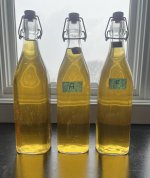
The bottom line is the mead. Since starting this approach, which includes use of GoFerm and Fermaid O, my mead has been flawless. It is obvious that my yeast are very happy. And the mead is delicious. Just to make your mouth water, here's a picture of three liter bottles from the most recent batch. It's a completely dry mead made from citrus blossom honey. You can see the little cubes inside two of the bottles. I'm experimenting with oaking, American and French medium toast (A & F). It was a snowy day.
 

Attachments

  • IMG_1349.jpeg
    IMG_1349.jpeg
    767.5 KB · Views: 3
  • Like
Reactions: darigoni
Please re-read my comments. Yes I use distilled water, which (of course) starts out stripped of all minerals. But I've read a lot about the mineral requirements of yeast and also the impact of various minerals on taste. Based on this knowledge, I can construct a water that yeast love. So that's what I do.

You hope to do the same thing. You accept whatever minerals the tap water contains, and then you add whatever minerals you get from the GoFerm and Fermaid O. But you're flying blind. You really don't know how much is in either source. You just make a giant act of faith that the combination of the tap water and the purchased supplements will add up OK.

I prefer to control my own destiny. I'd rather start with nothing in the water then build a mineralized water from scratch. One reason is that my tap (well) water has more chlorine than I want in the mead. Another is that I am quite certain that GoFerm and Fermaid O have less potassium and less phosphorus that my target. There's probably immaterial calcium, adequate zinc, and just adequate but suboptimal magnesium. It would be much easier if the manufacturer were more forthcoming.

The bottom line is the mead. Since starting this approach, which includes use of GoFerm and Fermaid O, my mead has been flawless. It is obvious that my yeast are very happy. And the mead is delicious. Just to make your mouth water, here's a picture of three liter bottles from the most recent batch. It's a completely dry mead made from citrus blossom honey. You can see the little cubes inside two of the bottles. I'm experimenting with oaking, American and French medium toast (A & F). It was a snowy day.
Well, the lab coats that are PH'd say that using the two products I mentioned, you also use, have said they provide all the nutrients needed. Why would they lie?

Even if they do, I have enough medals for making mead, including "first runner up" for Mead Maker of the Year. I have the water issue. I tested all the Artesian Spring water I can buy and found out which one makes the best mead> so I have zero reason to build water. Once my mead is finished, I can make the final tweaks to dial in my flavor profile. What else could you want?
 
Well, the lab coats that are PH'd say that using the two products I mentioned, you also use, have said they provide all the nutrients needed. Why would they lie?

Even if they do, I have enough medals for making mead, including "first runner up" for Mead Maker of the Year. I have the water issue. I tested all the Artesian Spring water I can buy and found out which one makes the best mead> so I have zero reason to build water. Once my mead is finished, I can make the final tweaks to dial in my flavor profile. What else could you want?
LOL -- I could want you to fulfill your promise and stop bothering me.
 
I just jumped in here (have been around for many years but recently felt that I should be more active here) and im not a native English speaking person. So I just want to know if this conversation is about the alkalinity of water? Or minerals of water in general and how it affects the yeast?
 

This article may have gotten me started on this track. Note my comment (Joe D) among those that follow the article.

Of course, the focus is pH. I think I've sorted the chemistry. My question in the OP was about taste and/or any other issues I may not have contemplated.
My FG never went past 1.05, SG was 1.1, i surfed the forum looking for possible answers and i think its either the pH or the water, i use RO water but the pH is abt 4 or 5, which i realised is a bit low. Im going to try lowering the ph first then im gonna try spring water to see if it has any effect. This problem has been following me since the beginning and im on my third batch and just realised my abv only goes up to 7% Max and i use ec1118 so there is sth Wrong here.
 
My FG never went past 1.05, SG was 1.1, i surfed the forum looking for possible answers and i think its either the pH or the water, i use RO water but the pH is abt 4 or 5, which i realised is a bit low. Im going to try lowering the ph first then im gonna try spring water to see if it has any effect. This problem has been following me since the beginning and im on my third batch and just realised my abv only goes up to 7% Max and i use ec1118 so there is sth Wrong here.
The pH is almost nothing to care about. The only time you might want to know what your pH is doing is if you're trying to copy a batch you already made. Then, you might want to check the pH of the first batch once it's finished and compare it to the finished pH of the second batch to see your pH. I would never use a monitor of any sort to finish your final weeks on a batch. Who cares what the Ph is? You must use your mouth for that every time.

EC is one of the strongest performers in yeastdom. Even mistreated, it should still yield a minimum of 16%. I'm not sure why you think you want to use RO water. You can, for sure. But good water tastes good because of the elements in suspension. That's why you will like some waters better than others. I would make a mead with your best-tasting water. RO is a desert; it doesn't add anything to taste and gives zero to your yeast performance.

If you use modern protocols, you don't even need to worry about the old wives' tale about yeast stalling when it reaches 3.0. I almost never see it go that low, and the few I have didn't struggle one bit. I have about 5 different water I can buy. I have made mead with all of them. I found that one tasted better than the others all the time. You might like of them better. I'm only saying that it behooves us to find out what water we have access to and use the one that gives you the best flavor you enjoy.

You can find the most modern protocol on the podcast here on 9/5/17
 
My FG never went past 1.05, SG was 1.1, i surfed the forum looking for possible answers and i think its either the pH or the water, i use RO water but the pH is abt 4 or 5, which i realised is a bit low. Im going to try lowering the ph first then im gonna try spring water to see if it has any effect. This problem has been following me since the beginning and im on my third batch and just realised my abv only goes up to 7% Max and i use ec1118 so there is sth Wrong here.

Ok, so there is few things to think of when you use RO-water. It has zero acidity buffering capabilities due to its lacking in all sorts of mineral and mostly not any HCO3. The pH can go everywhere during fermentation. So it’s not advisable to use if you want a steady fermentation. And for same reason it’s hard to adjust the acidity. The RO-water has an “unstable” effect on the fermentation. But if you brewing beer (which has a lot of grain) or have a lot of flavoring like me fruits and berries these contains some minerals to achieve a more stable solution. However if later on want stabilizing your mead with sulfites you can’t have over pH 3,8. It will not be effective over that pH. It is becoming more or less useless.
 
My FG never went past 1.05, SG was 1.1, i surfed the forum looking for possible answers and i think its either the pH or the water, i use RO water but the pH is abt 4 or 5, which i realised is a bit low. Im going to try lowering the ph first then im gonna try spring water to see if it has any effect. This problem has been following me since the beginning and im on my third batch and just realised my abv only goes up to 7% Max and i use ec1118 so there is sth Wrong here.
@mhal408 -- I haven't been back here for a while. . . . Without more info, it's tough to help. I agree that the yeast is not the problem. For mead, a pH around 4-5 is not low; something near 3.5 is better. I usually keep my fermentation between 3.2 and 3.6. Honey is notoriously infertile. So do you use nutrients? Inadequate N could be the problem. Also, if you start with RO water, then you have no minerals. You should add some. This will also help stabilize the pH.

Bottom line -- The growth of your yeast is stopping before the sugar is used up. It sounds like they are malnourished.
 
So update, i tried puting in more fermaidO and potassium carbonate, the fermentation started again.

I use RO because my drinking water is it, though i tried small batch with mineral water just to see if it has any effect but so far it looks the same as the RO, still fermenting.

So from the test batch, the water type doesnt seems to affect much, but i havent put in potassium carbonate yet, so i can yet see if pH plays a role here or not.

I also suspect lack of nitrogen, i used fermaidK before, what makes me suspect it is the coffeemel made it into the 10%+ without any intervention, maybe nitrogen from coffee ground helps? Also what kind of nutrition would i need beside fermaidO?
 
So update, i tried puting in more fermaidO and potassium carbonate, the fermentation started again.

I use RO because my drinking water is it, though i tried small batch with mineral water just to see if it has any effect but so far it looks the same as the RO, still fermenting.

So from the test batch, the water type doesnt seems to affect much, but i havent put in potassium carbonate yet, so i can yet see if pH plays a role here or not.

I also suspect lack of nitrogen, i used fermaidK before, what makes me suspect it is the coffeemel made it into the 10%+ without any intervention, maybe nitrogen from coffee ground helps? Also what kind of nutrition would i need beside fermaidO?
 
Go download this and do what it says. This is how I learned to make mead, and I took second place in The Mead Maker of the year, and many other awards in competitions.

 
So update, i tried puting in more fermaidO and potassium carbonate, the fermentation started again.

I use RO because my drinking water is it, though i tried small batch with mineral water just to see if it has any effect but so far it looks the same as the RO, still fermenting.

So from the test batch, the water type doesnt seems to affect much, but i havent put in potassium carbonate yet, so i can yet see if pH plays a role here or not.

I also suspect lack of nitrogen, i used fermaidK before, what makes me suspect it is the coffeemel made it into the 10%+ without any intervention, maybe nitrogen from coffee ground helps? Also what kind of nutrition would i need beside fermaidO?
Well that's good news.

Using RO because you drink it is a very casual approach. RO has no minerals, right? Zero. We know that yeast does best with substantial potassium, a decent amount of phosphorus and magnesium, some calcium, a little zinc, and so on. I have no idea what "mineral water" contains but I would strongly advise you not to continue to use RO without supplementing it. The short answer to your final question is: Minerals.

Using coffee because you drink it is, again, a very casual approach. Re nitrogen, one of the things that @Squatchy and I agree on is that Fermaid O is a good product. My only gripe is that I wish I knew exactly what's in it. I would suggest that you use it exclusively as your source of N. Coffee contains N but I have no idea how much. If you're content to be casual about it, you might also toss a hamburger into your must; it has nitrogen too. I think you'd be better of with an approach that is more precise.

I'm not going to make detailed recommendations here because I don't want to get into a food fight with other members who disagree. Maybe I'll answer a PM.

One last note: An active fermentation does not ensure a good-tasting product. I can assure you that your yeast can bubble for weeks and still produce a mead that tastes like medicine or smells like rotten eggs. You want your yeast to be very very happy. Figure out exactly how to make them happy.
 
Is there a certain water part in this forum? I think it could be a next level into mead making. Water is like beer/wine a substantial part of the beverage. I have been designing water myself quite much. Osmotic pressure from both honey, minerals and salt is interesting. If we take a brief look into the wine industry it’s crucial where the grape is grown and how the soil is effecting the final wine due to the grapes composition. Enough about it, I hijacked the thread. Sorry bout that.
 
@Cobrac -- Thanks for the comments. Consistent with your suggestion, I have been constructing my own water for mead fermentation for a few years. My approach follows whatever authoritative books or scientific articles I could find that directly and credibly address the question: What minerals are required to keep yeast happy? And to keep beer/mead drinkers happy? Many of these sources are listed above.

The minerals serve two basic purposes: (1) they provide nutrients, and (2) they buffer / modify pH. And these minerals must be added within certain constraints. One constraint is that the minerals should not interfere with healthy yeast metabolism. For example, sodium competes with hydrogen for transport out of the yeast cell, so too much sodium makes it difficult for the yeast cell to maintain an optimal internal pH. And of course, the minerals are added with boundary conditions to ensure that they not adversely impact taste. For example, abundant chloride might be OK per se combined with normal Ca, Na, and/or K could create a salty taste. Similarly, potassium per se seems ok in large amounts but can produce a salty flavor in the presence of excess chlorine. Similarly, ample zinc can encourage yeast metabolism but then can create a metallic taste. And it's not just taste. Ample magnesium is good for yeast metabolism but too much can have a laxative effect.

Bottom line: Fermenters ignore minerals at their peril. Distilled or RO water has no minerals, so if such water is used then supplements seem necessary. On the other hand, tap water or even purchased spring water will have minerals but maybe the wrong ones or the wrong amounts. As noted, my own well water has too much sodium and too much chloride to be optimal.

Also, while honey itself has some minerals, it does not have enough to ensure a healthy fermentation.

FWIW, I'd be very happy to discuss this topic. But I don't think I can do it here. My simple question in the OP, which asked whether there are reasons not to add potassium, elicited a close-minded response. Like me, you view water management as a potential "next level" in mead making. I was told categorically that adding minerals is passé -- everything you might ever need is already included in Fermaid O. But I want to know what I am doing and why.
 
Thank you all for the reply, i will study what said a bit deeper. Sorry if i sounded lazy, i just dont know what to do and ended up discovering stuff while i tried new stuff, resources are hard to find over here both in terms of material and knowledge. Thanks again.
 
Thank you all for the reply, i will study what said a bit deeper. Sorry if i sounded lazy, i just dont know what to do and ended up discovering stuff while i tried new stuff, resources are hard to find over here both in terms of material and knowledge. Thanks again.
I didn't intend to imply that you were lazy. My approach is the lazy one -- I try to learn from other people's work and copy the best practice. I was hoping to save you needless work, let you avoid making avoidable mistakes. Good luck.
 
I didn't intend to imply that you were lazy. My approach is the lazy one -- I try to learn from other people's work and copy the best practice. I was hoping to save you needless work, let you avoid making avoidable mistakes. Good luck.
Well im self aware that i am a bit lazy, im kind of afraid going down the rabbit hole cause i know makin mead can be very simple and can be very sophisticated, so like all things i always started simple then improve along the way, guess making mead is one of the hobby that actually sticks for me.