Mead Calculator Utility and TONSA

  • PATRONS: Did you know we've a chat function for you now? Look to the bottom of the screen, you can chat, set up rooms, talk to each other individually or in groups! Click 'Chat' at the right side of the chat window to open the chat up.
  • Love Gotmead and want to see it grow? Then consider supporting the site and becoming a Patron! If you're logged in, click on your username to the right of the menu to see how as little as $30/year can get you access to the patron areas and the patron Facebook group and to support Gotmead!
  • We now have a Patron-exclusive Facebook group! Patrons my join at The Gotmead Patron Group. You MUST answer the questions, providing your Patron membership, when you request to join so I can verify your Patron membership. If the questions aren't answered, the request will be turned down.

Hesster1977

NewBee
Registered Member
Apr 6, 2022
19
1
3
Mi
So I made my first batch of Mead after years of making Wine, and read everything from this site and others to prepare. The Mead Calculator Utility on this site is a great tool for figuring out the basics and impact of additional sugars. In addition, the Newbie Guide helped with basic guidelines and Nutrient additions. So my first batch absolutely blew through fermentation in a few days (outlined in my other thread "Stuck Fermentation"), and I don't want to repeat this on my next batch. I had followed the recommended staggered Nutrient additions, agitating, and so on to the letter but hit 1.000 in 4 days, I guess that is a hot fermentation for sure, and not sure how adverse this is on flavor, etc.
Cut to the chase now. More research uncovers a "TONSA" calculator, and it has a entry for "Specific Gravity of Fruit". Not sure how this would be determined. I do know the quantity, volume, and sugar content of my intended additions, and am able to plug this into the Mead Calculator. But for TONSA, how does one calculate what to enter for any Fruit or Juice, or just ignore that entry? Or just stick with the Newbie recommendation of staggered Fermaid and DAP additions over the first few days?
 
I usually add my fruit in the secondary stage (post fermentation), so don't have to account for the fruit sugars. If you've checked out the Mead Calculator, then you should have seen that it has a list of the more common fruit additions, which if chosen will give you an estimate of the sugar content of each. When using the calculator, there are three sections where you can add "Additional Sugars". When creating a batch, check off "Additional Sugars #2" and instead of Type = Honey, use the drop down box to pick the fruit you want to use.

FYI. If you want to slow down your fermentation, stop using DAP (which is like crack to yeast) and just use the Fermaid products. Preferably Fermaid O.
 
Last edited:
I have found a couple of TONSA Calculators, one on MeadMakr site, and one on Meadmaderight site. The Meadmakr Batchbuildr tool provides the option for 1) Fremaid O (Tonsa 2.0), 2) Fermaid K/DAP, and 3) Fermaid K/Fermaid K/DAP. So this tool provides the options of choosing different supplement combinations, and seems the one I could use.
So as recommended maybe stick with just Fermaid O as the supplement, given my "explosive" fermentation on my first batch with Fermaid K and DAP.
But, when selecting just Fermaid O as the supplement in these tools, it seems different amounts of Fermaid O can be calculated, of course depending on inputs, like Low/Medium/High Nitrogen requirement, and Sweetness Level. I assume it will ferment to Dry at 1.000? Then I can back sweeten as desired.
Example - for a 5 Gal batch with 18% ABV Yeast (K1V-1116) and a target 1.134 Starting Gravity fermented to dry @ 1.000 the total amount of Fermaid O that will be added to the must is 27.9g. The nutrients will be divided into 4 staggered nutrient additions @ ~7g each?
I am going to add Tart Cherries to my Primary. and understand how this is entered into the Mead Calculator, but DO NOT know what impact this may have on calculating Fermaid O addition amounts, or if it matters.
So can some seasoned Forum Members clarify direction for me, so I use this tool properly?
 
If you look at the MMR TOSNA calculator, you’ll see that there is a place to enter in the specific gravity of your primary fruit addition. This can be (roughly) calculated by using the Gotmead calculator as I described above; where you check off both batch size and Additional Sugars # 1, pick your fruit from the drop down menu and then enter in how many pounds of fruit you plan on using. This will give you the SG of ONLY your fruit. Or, you can enter in your honey quantity in Additional Sugars #1 and your fruit in Additional Sugars #2 (checking off the boxes for both) and this will give you the combined honey and fruit SG. You would use these figures in the the TOSNA calculators.

It’s your mead, but just because a yeast has an 18% ABV tolerance, doesn’t mean that you should make an 18% ABV mead. I would shoot for an ABV in the 10% to 13% range.
 
Last edited:
If you look at the MMR TOSNA calculator, you’ll see that there is a place to enter in the specific gravity of your primary fruit addition. This can be (roughly) calculated by using the Gotmead calculator as I described above; where you check off both batch size and Additional Sugars # 1, pick your fruit from the drop down menu and then enter in how many pounds of fruit you plan on using. This will give you the SG of ONLY your fruit. Or, you can enter in your honey quantity in Additional Sugars #1 and your fruit in Additional Sugars #2 (checking off the boxes for both) and this will give you the combined honey and fruit SG. You would use these figures in the the TOSNA calculators.
Thanks Brother! Mead time!
 
Hi Hesster1977,
You are also correct on the equal portions for SNA (per your question). A couple things you've probably read already, but the speed of fermentation isn't just about nutrients. Temperature is another key. I've found faster fermentations may taste fine, but can negatively impact aroma. I'm sure that's not a hard and fast 'rule', and just my experience to date. I've never had one get to 0 in 4 days, but I've certainly had them blow past the 1/3 break in 2 days.
TOSNA is a great guide (especially for Trads), but every batch is going to be different. This is more applicable when ingredients containing sugars are added to the fermentation - fruits may also contain YAN that the yeast can use as well. For the medium to high YAN requirement yeasts I've used, I've found that it's better to err on the side of caution and make sure they get enough nutrients. However, I've still slightly reduced some of my Ferm O additions when it seems the fermentation is in turbo mode. Playing temperature yo-yo isn't the greatest either, but in absence of temp control, I've moved my batches to a colder climate for a short time to slow them down just a bit.
I haven't done trials on it, but I've also wondered if overpitching 'too much' yeast can speed up a fermentation as well. It seems to make sense to me that if you have a higher yeast count (more workers) early on, then fermentation will go faster.
You may have this link already, but another reference for consideration:
I may need to reach out to you on the wine making topic. My first two batches are still aging, but initial impressions are that something went wrong. Never had a problem with a mead batch yet after 4 years. I have a Chilean Diablo Rojo kit I'm about to start up, so a bit nervous...
Happy meading!!!
 
Last edited:
  • Like
Reactions: darigoni
Appreciate all that feedback. Being very technical, I always research a project thoroughly as preparation. That means sifting through opinion’s, but nothing’s better than experience. The mead calculator and various Tonsa schedules take a lot of the guesswork out of the process. That said, all my wine kits only ever came with one 5g yeast packet for 5 to 6 gallon’s, but I went with two on my mead relying on forum input. Prob NOT necessary given feeding it with Dap and F-K. And, it was fermented in my basement which is at 64 degrees, which I thought was probably a little cool, but not after it took off and the fermenter was quiet warm to the touch. So this time, only using Ferm-O, and using a fan to keep temps down. The premium wine kits (many with skins) are forgiving, but like mead, best after aging in the bottle, esp the reds. Good after 6 months min, awesome after 1+ year(s).
 
I was the same way. I spent 4x the amount of time researching mead than I did in actually making mead. Consequently, I don’t think I ever had a bad batch.....
 
Hesster1977 said:
That said, all my wine kits only ever came with one 5g yeast packet for 5 to 6 gallon’s, but I went with two on my mead relying on forum input. Prob NOT necessary given feeding it with Dap and F-K. And, it was fermented in my basement which is at 64 degrees, which I thought was probably a little cool, but not after it took off and the fermenter was quiet warm to the touch

Don't worry about overpitching yeast, especially the inexpensive dry yeast as it will drop out when done. Not having enough yeast is the real problem as that can, counter intuitively, actually lead to a yeasty taste in your mead.

I think the best way I've heard DAP described is that it's like giving someone a steroid shot instead of giving them proper nutrition. I've used DAP on a fermentation that stalled early on and it certainly kick started it up again, but I think that's about the only way that I have used it.
 
  • Like
Reactions: darigoni
So now that my batch of Dragons Blood is marching along in an orderly fashion, I will patiently wait until it ferments out dry ~1.000 or so. Then My plan is to rack it onto some Tart Cherries to back sweeten it up, rack it off, age it, then bottle.
So this brings up the next item that the "Newbie" would appreciate input on - Sulfite additions. I have read countless articles and read many forum recommendations on the process, and when and how much to use. I understand you should measure the PH and test for Sulfite levels to correctly add a prescribed amount, but really, I don't want to spend a bunch on a PH meter and SO2 test kit stuff, nor go back to College for a Chemistry degree to sort this out. I see #grams, Tsp amounts, # Tabs, charts on PPM to ml to Gallons, etc. I am looking for a simple approach, but don't want to ruin my batch with chemicals.
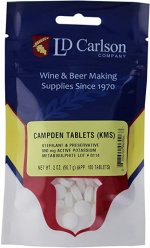
SO - I purchased some Potassium Campden Tabs on Amazon, and it says "550 mg Active PMB/tab, use 1 per Gal when racking". But the recommended amounts in the Forums are all over the map - 1/4 tab/5 gal, 1/2 tab/ 5 gal, 1 Tab/Gal, etc.
Questions -
1. Do I add any and how much at the 1st racking onto the Cherries? % or # of Tabs?
2. Then, certainly before bottling, but how much? % or # of Tabs?
 

Attachments

  • PMB tabs.jpg
    PMB tabs.jpg
    32 KB · Views: 2
I never used Campden tablets, but did buy bags of both potassium metabisulfite and potassium sorbate. I followed the directions on the bags for both and never had any issues.
 
Hesster1977 said:
I purchased some Potassium Campden Tabs on Amazon, and it says "550 mg Active PMB/tab, use 1 per Gal when racking". But the recommended amounts in the Forums are all over the map - 1/4 tab/5 gal, 1/2 tab/ 5 gal, 1 Tab/Gal, etc.
Questions -
1. Do I add any and how much at the 1st racking onto the Cherries? % or # of Tabs?
2. Then, certainly before bottling, but how much? % or # of Tabs?
I can't help much with campden tablets. Those are the shotgun approach of use this and you should be good; and you probably will be.

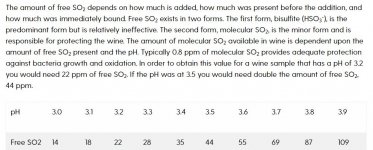
The Campden is most likely Potassium Metabisulphite (K-Meta) and the proper amount to use is based on the pH that you are treating. A digital pH meter is ~$40 and probably is worth getting if only to try and get the stabilizing amounts correct/close to what you need without going over.

The higher pH translates to more K-Meta and the reverse is true.

SO2 amounts.JPG
 
Any recommendations on a ph meter? I know this opens a can of worms as I have read thru various posts on what to get. Milwaukee keeps standing out, but at $126 for infrequent use seems a little excessive.
 
I don‘t want to post a link in case it violates forum rules, but if you search for „pH meter“ on a well known online retailer site you get lots of hits for a unit selling between 10 - 20 USD. I had one like this and it didn‘t last long although I think the results were okay when it worked. Now I‘ve got the one listed between 30 - 50 USD which has integrated thermometer and 3 point calibration. So far I‘m happy with it and it seems very stable and precise.
 
This is the one that I use: HM Digital PH-80. (About $30)
It works well and supports calibrating at 4.0 and 7.0

I purchased 4.0 calibrating fluid so that I'm calibrated the closest to the range that I will be testing. A calibration should be done at least once a month to make sure you are good; I calibrate just about every time I use the meter.

You will also want to purchase some electrode storage solution as the meter only comes with a tiny amount of calibration and storage solutions.
 
Last edited:
  • Like
Reactions: darigoni
Some updates, and a question. Got the PH meter and solutions, easy to calibrate. Started the batch 4/23, SG was 1.118. Got In 3 Ferm-O addition’s in before I hit the sugar break. Stirred daily with a drill until 5/2 then daily with a spoon. Removed the cherry bag on 4/30. PH measured ~3.5 on 5/2. So it’s been about 2-1/2 weeks in now and the SG is staying at 1.004 for the last 3 days. Taste is good. WHEN TO RACK???
 
So you are at 14.84% ABV. You *might* be done based on the alcohol level.
I would wait about a total 7 days to see if it stays stuck there.

Which yeast did you end up using? If you used an Ale yeast, you are almost certainly done with fermentation, but I would still wait and check at the end of the 7th day.

If you do end up waiting a few more days, you might want to move your carboy to a higher location for your auto siphon, if you need it to be higher than it is now, so that the extra few days it lets more items settle out and you don't disturb it moving it prior to racking.

As you now have a pH meter, here's some more info on stabilizing.
 
Thanks MM, will wait another week, used K1V1116. Just wasn’t sure if it was not good to sit on the heavy lees. Gets real cloudy when stirred. Been careful, using a Sodastream to blow CO2 in the fermenter when the lid goes back on. Got the fermenter on a table so I don’t need to move it. I am more informed on racking, Kmeta/PH, Sorbite, etc since I already did this on my first “adventurous” batch of ginger mead. So thinking my next step is to rack onto my calculated amount of Backsweeting cherries, age for “X” time, rack and add KMet and then Sorbate the next day, and age. Sound right?
 
V116 is tolerant up to 18%. It could still work your mead completely dry and end up in the 15.5% range. I would definitely wait the extra days to be sure it's done.

Depending on temperature, your primary fermentation could take a month to finish and sitting on the lees for another month, generally, wouldn't produce off flavors so I don't think you have much to work about getting it racked sooner than later. Some yeast like D47 will develop tropical and citrusy flavors when left on the lees. Read the yeast info sheet online to see if there are specific recommendations and temperature ranges.

The recommendations that I have always followed was to rack onto your stabilizing chemicals and give it at least 24 hours for the Sorbate to have a chance at stunning the yeast so that added sugars (wherever they come from, including your cherries) don't kick the yeast back into active fermentation.

Related to the above statement, adding your cherries, juices, or even honey plays into the dilution of your mead. That will actually drop your ABV based on how much was added. If the yeast were at their ABV tolerance, the dilution could give them enough leeway to start fermenting again. With all of that in mind, it is why the stabilizing happens prior to adding items that will dilute and/or add sugar that might restart fermentation.

I hope that wasn't too verbose.